Outdoor catering logistics is the planning and coordination of food, equipment, people, and service at a location that is not a permanent kitchen or dining room. For outdoor events, temperature control should be planned before selecting a scenic backdrop: first establish safe food-holding capacity, transport routes, shade, power, and backup options, then choose a setting that can support them. The U.S. Food and Drug Administration’s Food Code generally calls for time/temperature control for safety foods to be held at 41°F (5°C) or below when cold and 135°F (57°C) or above when hot. These limits make temperature planning a practical constraint on venue choice—not a detail to solve after the view is selected.
Outdoor Catering Logistics and Temperature Control
Temperature control in outdoor catering is the set of procedures and equipment used to keep food within safe limits during preparation, transport, storage, service, and disposal. The FDA Food Code provides a model framework for retail food safety; local health departments adopt or adapt requirements, so caterers should confirm the rules for the event’s jurisdiction. The central operating limits are cold holding at 41°F or less and hot holding at 135°F or more. Food between those limits can enter the temperature “danger zone,” where pathogens may grow if time and conditions permit.
The Centers for Disease Control and Prevention (CDC) estimates that foodborne illnesses cause about 48 million illnesses, 128,000 hospitalizations, and 3,000 deaths in the United States each year. Those figures cover foodborne illness broadly, not outdoor catering alone, but they illustrate why a beautiful location cannot substitute for controlled handling. Outdoor service adds exposure to heat, sun, wind, dust, insects, long travel distances, and unreliable utilities. Consequently, site selection should follow a feasibility check for food safety and service capacity.
Cold holding and transport
Cold holding means maintaining food that requires temperature control at 41°F or below, including during delivery and display. Use insulated food carriers or refrigerated vehicles, keep containers closed, separate raw products from ready-to-eat foods, and measure temperatures with a calibrated food thermometer rather than judging by touch. The FDA Food Code’s time-as-a-public-health-control provisions allow limited use of time instead of temperature only under specified written procedures and time limits; this should not be improvised as a workaround for inadequate refrigeration.
Hot holding and service
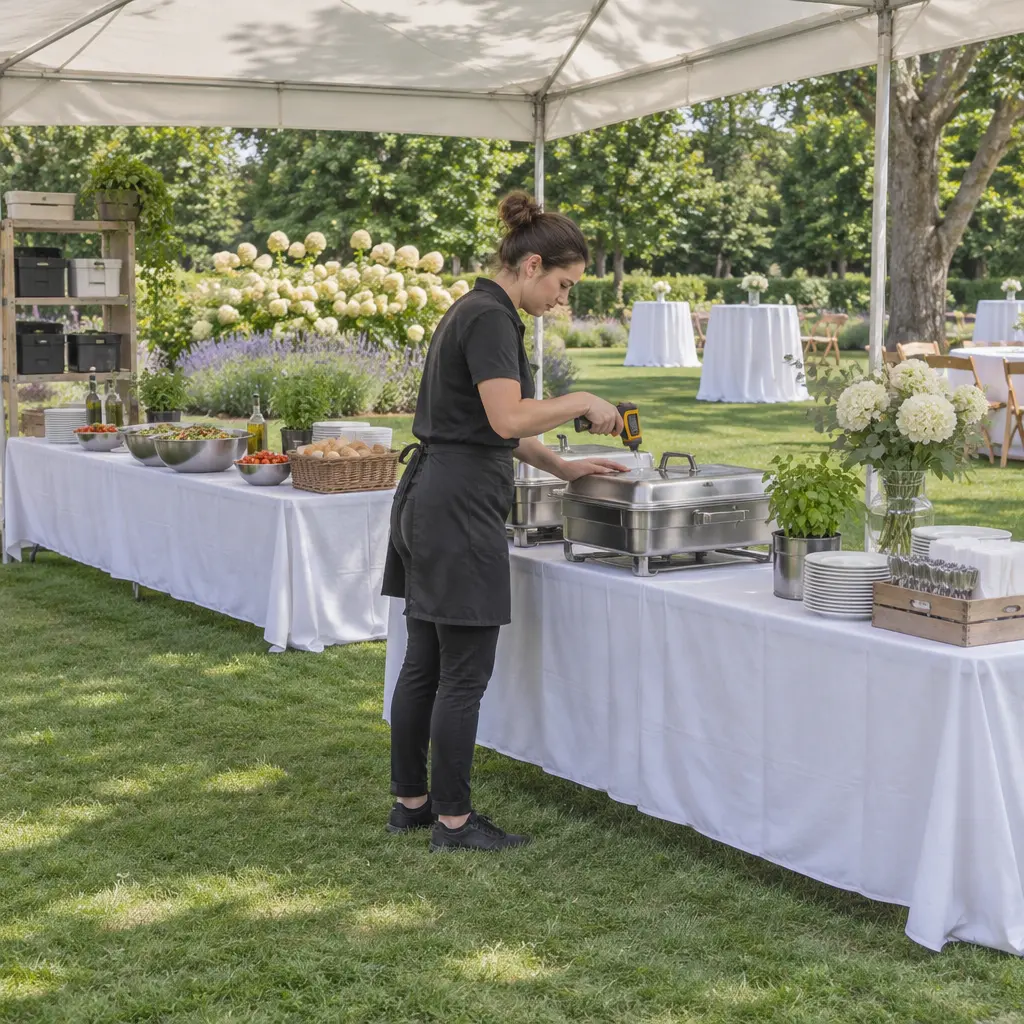
Hot holding is maintaining cooked, temperature-sensitive food at 135°F or above after cooking and before service. Insulated hot boxes, covered pans, approved warming equipment, and short, controlled service windows help prevent cooling. Reheating requirements differ from holding requirements: under the FDA Food Code model, food cooked and cooled for hot holding generally must be reheated to 165°F for 15 seconds within two hours. A caterer should verify the applicable local code and record temperatures at planned checkpoints.
Time, monitoring, and corrective action
Temperature monitoring is the documented measurement of food and equipment conditions at defined stages. A practical plan names who checks each unit, when readings are taken, what thermometer is used, and what happens when a limit is missed. Corrective actions may include moving food to functioning equipment, rapidly restoring safe conditions when permitted, replacing affected food, or discarding it. The FDA Food Code includes a general maximum of four hours for certain foods under approved time-control procedures, with specific marking and disposal rules; operators should not apply that allowance without checking the precise conditions and local adoption.
Outdoor Catering Logistics and Site Feasibility
Site feasibility is the assessment of whether a location can support safe preparation, transport, holding, service, and waste handling. It links food safety with practical operations: a remote overlook may offer a striking view but lack vehicle access, shade, potable water, power, or space for refrigerated storage. The National Weather Service’s heat-safety guidance also matters because high temperatures can affect both workers and equipment. The venue review should therefore test the food-service plan before the event team commits to a backdrop.
Access, distance, and delivery route
A delivery route is the path from the licensed kitchen or commissary to the event’s receiving and service areas. Route assessment should account for travel time, traffic, vehicle loading, stairs or uneven ground, restricted vehicle access, and the distance from unloading to service. Longer or less predictable journeys increase the importance of insulated carriers, temperature checks at dispatch and arrival, and a clear handoff. A scenic site should be rejected or redesigned if food cannot be transported and transferred without compromising temperature control.
Shade, weather, and equipment protection
Environmental protection means reducing the effects of direct sunlight, ambient heat, wind, rain, and dust on food and equipment. Place service tables and holding units under stable shade where possible, keep food covered, and avoid positioning refrigeration or hot-holding equipment where ventilation is blocked. Forecasts should be checked before the event and again on the day; a heat, wind, or storm contingency may require a tent, indoor alternative, delayed service, or relocation. Shade supports operational stability, but it does not replace temperature measurement.
Utilities, water, and sanitation
Utility readiness is the confirmed availability of electrical capacity, potable water, handwashing facilities, and approved wastewater and refuse arrangements. Caterers should verify outlet locations, circuit capacity, generator rules, cable protection, and backup power before relying on electric refrigeration or warming equipment. The FDA Food Code contains requirements for handwashing and food-facility sanitation; event operators should coordinate with the local health department on temporary food-service permits and site-specific conditions. If essential services cannot be provided safely, choose a different service model or location.
Outdoor Catering Logistics and Backdrop Selection
Backdrop selection is the choice of the event’s visual setting, such as a garden, waterfront, vineyard, rooftop, or mountain viewpoint. In temperature-controlled catering, the backdrop is a constrained design choice: it should be selected only after the service footprint, cold and hot holding, route, utilities, shade, and emergency plan have been validated. This order protects both guests and the event budget by preventing late changes to equipment, staffing, or menu.
Match the menu to the location
Menu-to-site matching means choosing foods and service formats that the location can support safely. A remote site with limited power may favor a menu that can be transported in sealed, temperature-controlled carriers and served promptly, rather than a complex menu requiring extensive on-site cooking and refrigeration. Smaller service batches, covered displays, and replenishment from protected holding equipment can reduce exposure during a long reception. The menu still needs to meet applicable food-safety controls; simplicity does not eliminate temperature requirements.
Build a service footprint before approving the view
A service footprint is the mapped area for unloading, handwashing, food storage, preparation, holding, guest service, and waste collection. Before approving a scenic site, mark the food-service zone and confirm that it is level, accessible, protected from weather, and separated from guest traffic where necessary. A diagram can show the route from vehicle to holding equipment to serving station, alongside power and water points. This simple site plan helps identify whether the desired photography angle conflicts with safe operations.
Use a decision gate and backup plan
A decision gate is a documented go/no-go review that must be passed before the venue or backdrop is finalized. The review should confirm permits, equipment capacity, temperature logs, staffing, weather protection, access, and contingency arrangements. For example, a waterfront reception may proceed only if the caterer can establish a shaded service tent, maintain cold holding, secure power or validated alternatives, and move food indoors if severe weather develops. This is a planning example, not a claim about a particular event; the same method applies to parks, estates, and remote viewpoints.
Outdoor Catering Logistics and Operational Checklist
A written event plan translates safety limits into assigned tasks. It should identify the responsible food-safety lead, equipment, monitoring schedule, contact numbers, and corrective actions. The following sequence keeps temperature control ahead of aesthetic decisions:
- Confirm local health-department requirements, permits, and any venue restrictions.
- Inventory menu items by required cold holding, hot holding, cooking, reheating, and service needs.
- Map the kitchen-to-event route and estimate transport and setup times.
- Verify refrigeration, hot-holding capacity, power, potable water, handwashing, shade, and weather protection.
- Assign staff to take and record temperatures at dispatch, arrival, holding, and service checkpoints.
- Set written corrective actions and identify a backup location, equipment source, or service adjustment.
- Approve the scenic backdrop only after the operational review passes.
A useful planning graphic is a temperature-and-timeline chart with columns for food item, dispatch temperature, arrival temperature, holding equipment, scheduled checks, and corrective action. A separate site diagram can show the service footprint and guest flow. These tools make the connection between logistics and venue choice visible to the caterer, planner, and venue manager.
Conclusion: Put Temperature Control Before the Scenic Backdrop
Outdoor catering logistics depends on maintaining safe temperatures throughout transport, holding, and service while accounting for weather, access, utilities, sanitation, and staff needs. FDA Food Code model limits—41°F or below for cold holding and 135°F or above for hot holding—provide important planning benchmarks, subject to local adoption and requirements. The safest sequence is to validate the menu and equipment, assess the route and site, prepare monitoring and backup plans, and only then select the scenic backdrop. Event planners and caterers should consult their local health department, document a site-specific food-safety plan, and treat an operationally unsuitable location as a reason to change the design rather than compromise food safety.
Sources: U.S. Food and Drug Administration, FDA Food Code 2022, https://www.fda.gov/food/fda-food-code/food-code-2022; Centers for Disease Control and Prevention, Food Safety, https://www.cdc.gov/food-safety/; National Weather Service, Heat Safety, https://www.weather.gov/safety/heat; U.S. Food and Drug Administration, Food Code 2022: Time/Temperature Control for Safety Food and Time as a Public Health Control, https://www.fda.gov/food/fda-food-code/food-code-2022