
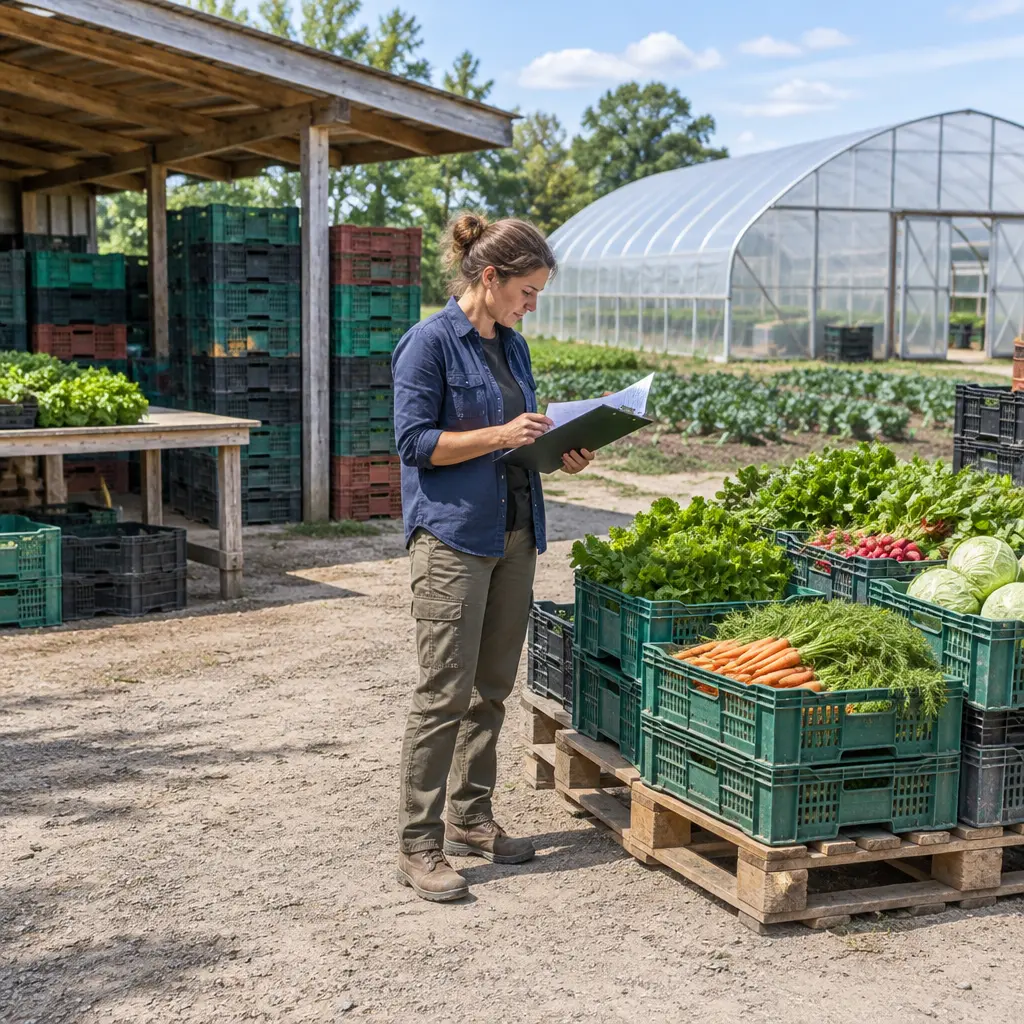
Farm-to-table sourcing is the procurement of food from farms and other producers through supply relationships that a restaurant or retailer can describe and substantiate. It is not a single legal certification: “local” and “farm-to-table” can mean different things in different contexts, so diners and buyers should look beyond menu language. A reliable assessment checks who produced the food, where and when it was produced, how it reached the business, and what records or direct relationships support the claim. Those checks matter in a food system where the U.S. Department of Agriculture’s 2022 Census of Agriculture counted about 1.9 million farms, while the National Restaurant Association has identified local sourcing as a continuing consumer and restaurant-industry interest. Supplier records, traceability practices, meaningful definitions of “local,” and transparent communication help distinguish verifiable sourcing from marketing alone.
Farm-to-Table Sourcing Defines Verifiable Supplier Relationships
The U.S. Food and Drug Administration describes traceability as the ability to follow food through production and distribution. Applied to farm-to-table claims, that means a business can connect a menu item or product to an identifiable supplier and, where feasible, to the farm or producer behind it. A direct purchase is one possible relationship, but a distributor-mediated purchase can also be transparent if the business can identify the producer and substantiate the product’s origin.
The U.S. Department of Agriculture’s Agricultural Marketing Service explains that “local” does not have one universally applicable federal definition for all food marketing. Some federal programs use specific geographic standards, but those standards should not be assumed to govern every restaurant claim. A restaurant should therefore state what its own term means—for example, food grown within a named region, sourced from a stated radius, or purchased directly from listed farms.
Relevant supplier relationships include direct farm purchasing, cooperative or food-hub purchasing, and purchasing through wholesalers or broadline distributors. These are different sourcing pathways, not automatic measures of quality or proximity. The useful test is whether the pathway, origin, and evidence match the claim.
Supplier Documentation Verifies Farm-to-Table Sourcing
Documentation turns a sourcing statement into a claim that can be checked. The FDA’s Food Traceability Rule establishes additional recordkeeping requirements for certain foods on the Food Traceability List, with records designed to help trace food through specified critical tracking events. The rule does not certify that food is local or farm-to-table, and not every food or business is covered in the same way; it does illustrate why clear product and transaction records matter.
Invoices and purchase records
An invoice or purchase order can establish the seller, product, transaction date, and quantity. For a stronger origin check, it should also identify the farm or producer rather than only a distributor, where that information is available. Match records to the claim being made: an invoice for “apples” from a wholesaler supports a purchase, but it does not by itself prove which farm grew them.
Farm identity and product-level traceability
A supplier roster should name farms or producers and clarify which products they supply and during what season. Lot codes, harvest dates, delivery records, and packing labels can connect a product to a shipment or production batch. FDA traceability requirements emphasize standardized key data elements and event records for covered foods; businesses can adopt comparable practices voluntarily for other products to make origin claims easier to substantiate.
Audits, certifications, and their limits
Third-party certifications can validate specific practices, such as organic production under USDA rules, but they do not automatically prove that food is locally sourced or that a restaurant buys directly from a farm. Likewise, a farm visit can provide useful context but is not a substitute for records covering the products actually purchased. Treat each credential as evidence for the particular attribute it evaluates, not as blanket proof of every marketing claim.
Geographic Claims Give Farm-to-Table Sourcing a Clear Meaning
Geography is central to many farm-to-table messages, but the word “local” is ambiguous unless the business specifies a boundary and applies it consistently. The USDA’s Economic Research Service has noted that local food systems are commonly described using geographic proximity, direct marketing channels, or both; there is no single definition that fits every use. A restaurant’s sourcing policy should make its chosen interpretation visible.
Distance, region, and growing season
A defined radius, named state or watershed, or regional boundary gives customers a standard they can understand. The policy should explain whether distance is measured from the farm to the restaurant, distribution point, or another location. It should also account for seasonality: a menu may feature local tomatoes in summer while using produce from farther away in winter. Seasonal substitutions should be described honestly rather than hidden behind a year-round local claim.
Direct trade and intermediated sourcing
Direct trade means the buyer purchases from the producer without a conventional intermediary; it can strengthen communication, but it is not synonymous with local, sustainable, or fair. Food hubs and cooperatives aggregate products from multiple farms, while distributors may combine goods from many origins. These models can help small producers reach restaurants, but buyers should request producer-level origin details when making farm-specific claims.
A practical claim-to-evidence check
A simple verification process compares the wording of a claim with the available evidence. For example, “sourced from farms within 100 miles” calls for a stated geographic method and supplier locations; “from Green Valley Farm” calls for records connecting that farm to the item or shipment. If the business cannot verify every ingredient in a dish, it should narrow the claim to the ingredients it can substantiate.
Transparency and Resilience Strengthen Farm-to-Table Sourcing
Transparent sourcing is more than publishing farm names. It includes communicating what is purchased, how often suppliers change, which products are seasonal, and what happens when a farm cannot deliver. This clarity helps customers evaluate claims and gives businesses a practical way to manage supply disruptions.
Supplier relationships and purchasing commitments
A durable relationship may include forecast sharing, agreed quality specifications, payment terms, and a plan for seasonal availability. These practices can make procurement more predictable for both restaurant and farm, although the existence of a relationship alone does not prove that every advertised item came from that supplier. Purchase records remain important.
Food safety and origin records
Traceability supports more than marketing: it can help identify affected products during a food-safety investigation or recall. The FDA’s Food Traceability Rule is intended to improve the speed and effectiveness of tracing certain foods through the supply chain. Restaurants should keep supplier contact information and receiving records accessible, follow applicable food-safety requirements, and avoid presenting traceability as a guarantee that food is risk-free.
Real-world seasonal example
Consider a restaurant that advertises a summer salad as “from nearby farms.” A credible account might identify the farms supplying greens and tomatoes, define “nearby” as a specific region, and retain invoices and delivery records. If a storm interrupts harvest and the restaurant substitutes produce from a regional distributor, it can update the menu language or identify the substitution. The example illustrates how traceable records and timely disclosure keep a sourcing claim accurate as conditions change.
Conclusion: Verify Farm-to-Table Sourcing with Specific Evidence
Farm-to-table sourcing is most credible when supplier relationships are identifiable, geographic terms are defined, and documentation supports the claim at the product level. Invoices, farm and producer records, shipment details, and appropriate certifications each provide different kinds of evidence; none should be stretched beyond what it verifies. Clear sourcing policies also recognize seasonal variation and distinguish direct purchases from distributor-mediated ones.
For restaurants, retailers, and diners, the practical next step is to ask precise questions: Which farm produced this item? What does “local” mean here? Can the business connect the product to a supplier record? Businesses should publish concise answers and review claims regularly. This approach rewards genuine supplier relationships while helping customers make informed choices.
Sources: U.S. Department of Agriculture, 2022 Census of Agriculture, https://www.nass.usda.gov/Publications/AgCensus/2022/; U.S. Department of Agriculture, Agricultural Marketing Service, Local and Regional Food Systems, https://www.ams.usda.gov/services/local-regional; U.S. Department of Agriculture, Economic Research Service, Local Food Systems: Concepts, Impacts, and Issues, https://www.ers.usda.gov/publications/pub-details/?pubid=46393; U.S. Food and Drug Administration, Food Traceability, https://www.fda.gov/food/food-safety-modernization-act-fsma/food-traceability; U.S. Food and Drug Administration, FSMA Final Rule on Requirements for Additional Traceability Records for Certain Foods, https://www.fda.gov/food/food-safety-modernization-act-fsma/fsma-final-rule-requirements-additional-traceability-records-certain-foods; U.S. Department of Agriculture, Agricultural Marketing Service, National Organic Program, https://www.ams.usda.gov/about-ams/programs-offices/national-organic-program; National Restaurant Association, Research and Reports, https://restaurant.org/research-and-media/research/.


